

Web design · Data protection & compliance
5 reasonsWhy your website must be GDPR compliant
Fines of up to 20 million euros or 4 % of global annual turnover — and in Germany, simply using a Google font that wasn’t locally hosted was enough to trigger a fine. This guide explains what is required on your website and how data protection affects both trust and SEO.

- range of fines
- Up to €20mor 4 % of global annual turnover
- Scope
- Also outside the EUonce EU users are targeted
- Affected data
- Schon IP & Cookiesnot first name and email address
- Company size
- No lower limitstart-ups have also already been prosecuted
Introduction
With the increasing reliance on digital platforms for business, marketing and customer engagement, data protection has become a critical issue — particularly within the European Union.
The General Data Protection Regulation (GDPR) was introduced to give users more control over how their personal data is collected, processed and stored. Regardless of whether you are a small business owner, a start-up founder or a web manager in a company — ensuring that your website is GDPR-compliant is no longer just a recommendation, but statutory requirement.
In this post, we show you five compelling reasons why your website must comply with the GDPR and how this can have a positive long-term impact on your business.
Note
This post provides a technical and design overview and does not replace legal advice. For the binding assessment of your individual case — particularly regarding privacy policies, data processing agreements and third-country transfers — please contact a law firm or your data protection officer.
It's the law — avoid legal penalties
The most obvious reason to prioritise GDPR compliance is its legal necessity for any website that processes personal data of users within the European Union. This includes not only companies based in the EU, but also those outside the region if they target EU users.
Failure to comply may result in substantial financial penalties. The GDPR framework provides for fines of up to 20 million euros or 4 % of a company’s global annual turnover — whichever is higher. This means that even minor breaches can have devastating financial consequences.
And these are not hypothetical threats — real-world examples show that well-known companies have been fined for seemingly simple violations, such as:
- Use of Google Fonts without local hosting (a case that led to a fine in Germany)
- No proper consent for the use of cookies before loading tracking scripts
- No clear opt-out options on newsletter sign-ups or data collection forms
Even start-ups and small businesses were affected, demonstrating that no company is too small to be exempt from enforcement.
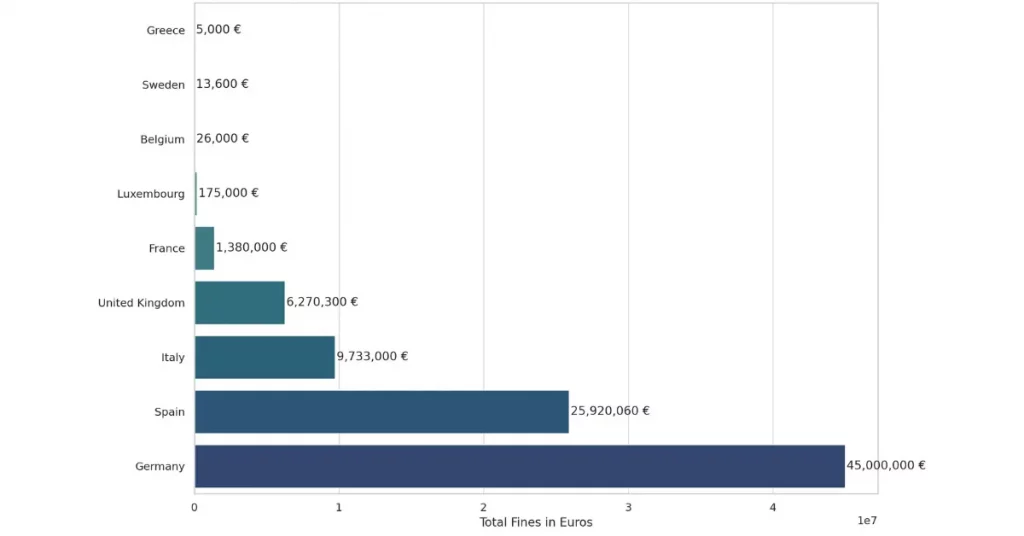
Source: enforcementtracker.com
Do you need help?
Synext IT provides complete GDPR setup and integration for WordPress, Shopify and custom websites.
Protect your customers' data and their trust
Beyond legal obligations, GDPR compliance shows your customers that you take data protection seriously. In an era when cyber threats, identity theft and digital surveillance are on the rise, users want to be sure that their personal information is in safe hands.
The GDPR dictates that websites:
- Clearly explain how and why data is collected
- Use secure connections (SSL/HTTPS)
- Store and process data with appropriate encryption and security measures
- Give users the right to view, correct or delete their data at any time
This transparency and control do not just tick a legal compliance box — they strengthen trust in your brand. When visitors see proper cookie banners, privacy notices and consent forms, they are more likely to trust your business and continue using your services.
Enhance your credibility and brand image
A GDPR-compliant website has a positive impact on your brand's reputation. Consumers are increasingly aware of data protection rights. They are choosing more consciously which platforms and companies they interact with. If your website lacks features for GDPR compliance, it has a deterrent effect — potential customers might leave the site even before engaging.
GDPR compliance encompasses visual and functional features that users recognise:
Compliant cookie banners
Properly implemented means: without pre-ticked boxes and with a reject option that is just as easy to find as the consent.
Accessible privacy policy
Accessible from any page, clearly worded and relating to the services actually in use — not as a boilerplate text.
Transparent opt-in procedures
Forms and newsletter subscriptions obtain active consent instead of presuming it through default settings.
Professionalism as a signal
These elements convey care and ethical responsibility — crucial factors for brand loyalty in the competition.
Improve SEO and website performance
What many companies do not know: GDPR compliance can improve your website's SEO and user experience. Search engines like Google favour websites that are secure, fast and trustworthy — all of which align with GDPR best practices.
Some ways in which GDPR compliance improves SEO and performance:
- Local hosting of resources such as Google Fonts and scripts reduces external requests and improves loading speed
- Omitting unnecessary tracking scripts improves the Core Web Vitals
- Clear navigation and structured privacy notices increase dwell time and lower the bounce rate
Furthermore, the GDPR overlaps with aspects of technical SEO — such as crawlability, mobile optimisation and secure connections — which can give your website a ranking advantage while keeping it compliant.
The same lever, double the benefit
Local fonts and fewer third-party scripts are both a data protection and a performance measure. Read more about how this affects mobile delivery in the article Mobile First and Responsive Web Design.
Secure use of marketing & analytics tools
From Google Analytics and Hotjar to Mailchimp and HubSpot — most modern websites use third-party tools to analyse user behaviour, generate leads or automate marketing. The catch: these tools process personal data and, if configured incorrectly, can lead to GDPR violations.
To remain compliant while using these tools, your website must:
- Anonymising IP addresses in analysis tools
- Obtain explicit, granular consent before loading non-essential scripts
- Offer simple opt-out or unsubscribe options for newsletters
- Store records of granted consents for audits
For example, Google Analytics must be set up with a data processing agreement, IP anonymisation and consent-based loading behaviour. Contact forms must contain unchecked checkboxes for data agreements and must not pre-select user consents.
These details may seem small — yet ignoring them can seriously jeopardise your business.
Typical function blocks and their correct setup
| component | Typical risk | Correct setup |
|---|---|---|
| Google Fonts | Font is loaded from the external server, the IP address is transmitted along with it | Embed fonts locally and serve them from your own server |
| Google Analytics | Tracking starts before consent | Data processing agreement, IP anonymisation, loading only after consent |
| Cookie banner | Pre-selected boxes, rejecting only accessible via hidden menus | Granular selection, equivalent reject option, documented consent |
| Contact forms | Consent is pre-selected or missing entirely | Disabled checkbox, clear purpose, encrypted transmission |
| Newsletter | No proof of registration, no easy deregistration | Double opt-in with log, unsubscribe link in every message |
| Embedded content | Videos, maps or fonts load data when the page is loaded | two-click solution or local hosting, loading only after consent |
How a web design agency helps with GDPR compliance
Creating a GDPR-compliant website means far more than simply inserting a cookie banner or linking to a privacy policy — it requires deep integration into design, code and content. This is precisely where an experienced web design agency like Synext IT becomes an indispensable partner.
We support you with
Technical implementation — the legal assessment remains with your legal counsel.
- Implementation of legally compliant cookie management systems (e.g. Complianz, Borlabs)
- Adaptation and localisation of the privacy policy and legal notice
- Local inclusion of external files (e.g. fonts, scripts)
- Configuration of contact forms, booking systems and newsletter opt-ins with correct consent
- Full GDPR compliance on multilingual websites through tools like TranslatePress
- Technical SEO support in accordance with the „privacy-by-design“ principle
Working with a GDPR-experienced agency saves you time, stress and potential legal issues — while simultaneously ensuring a better, safer user experience.
Self-check: Where does your website stand?
Tick off what applies to your website. The result is not a legal assessment, but rather a classification of how urgent the need for action is.
Most of these points are technical in nature and can be resolved within a few working days. Your legal counsel remains responsible for the legal assessment of your individual case.
Frequently Asked Questions (FAQ) — GDPR Compliance for Websites
How do I make my website GDPR compliant?
To make your website GDPR-compliant, you should:
- Display a valid cookie banner before non-essential cookies are loaded
- Provide a clear privacy policy explaining which data is collected and for what purpose
- Implement secure data processing, e.g. SSL encryption and protected forms
- Allow users to consent to or decline the use of cookies and marketing measures
- Offer rights to view, delete or amend your data
- Record consents and store them for audits
Do I need the GDPR for my website?
Yes. If your website has visitors from the EU and collects any type of personal data (e.g. email address, cookies, IP address), compliance with the GDPR is legally required — regardless of the location of your business.
Do US websites have to be GDPR compliant?
Definitely — if you serve users in the EU or specifically target them, the GDPR applies to you. This affects online shops, SaaS platforms and even informational sites with analytics functions.
How do I add the GDPR to my website?
- Use a professional cookie consent tool (not a simple pop-up)
- Add a privacy policy and a legal notice
- Ensure all forms contain explicit consent checkboxes
- Host Google Fonts, analytics tools and embedded content locally whenever possible
Next step
Check first, retrofit later.
Most websites fail on four or five recurring points — external fonts, scripts loading too early, pre-selected checkboxes. A check shows where you stand in minutes.
- Reply within 24 hours
- 100 % (no obligation)
- Specific findings rather than general guidelines
Performance
GDPR setup
Cookie management, local integration of external files, clean forms and consent documentation — for WordPress, Shopify and custom websites.
View servicesTechnical implementation · no legal advice
 English
  German