
Webdesign · Recht & Compliance
Accessibility Act 2025What websites must now comply with in the EU
Legally binding digital accessibility requirements will apply from 28 June 2025 – for the first time, also for private companies. This guide shows who is affected, which standards apply, and how to check your website in just a few minutes.
- Effective from
- 28 June 2025Transitional periods only in exceptional cases
- Scale
- WCAG 2.1 Level AAabout EN 301 549
- Affected
- B2C servicesShops, Banks, Booking, Telecom
- Exception
- Small businessFewer than 10 employees and ≤ €2 million turnover
Overview
The Accessibility Strengthening Act (BFSG) implements the European Accessibility Act (Directive (EU) 2019/882) into German law. It applies from 28 June 2025 and obliges providers to make digital products and services usable for everyone, especially for people with disabilities.
The crucial difference from the previous legal situation: Accessibility was long a duty of public bodies. With the BFSG, it now also covers private companies with digital offerings such as websites, apps or e-commerce platforms.
In this post, we'll clarify which companies are affected, what the specific requirements are, and how to plan the implementation. The aim is not only to avoid legal risks but to create a better, more inclusive user experience for everyone.
What is the Accessibility Act 2025?
The BFSG is the German implementation of a EU-wide directive that aims to make digital products and services more accessible for people with disabilities. It extends accessibility requirements to private providers – no longer just public websites. Among those affected are online shops, financial service providers, digital platforms, and mobile apps.
Exemption for micro-businesses
Businesses with fewer than ten employees and Annual turnover or annual balance sheet total of at most €2 million is exempt from the essential obligations of the Services Act. Both criteria must be met jointly.
What changes does this law bring about?
Companies must adapt or redesign their websites to meet legally defined standards – particularly after WCAG 2.1 Level AA. The law causes:
- More inclusive digital environments for all user groups
- Uniform legal requirements in all EU member states
- Penalties for non-compliance, up to and including service prohibition
These changes are intended to encourage businesses to see accessibility not just as an obligation, but as a competitive advantage: better usability, greater reach, and measurably lower bounce rates.
Is your website affected by the BFSG?
Our free testing tool analyses your homepage for contrast, alt-text, form labels and structure — and shows you the findings sorted by WCAG criteria.
Who benefits from this law?
Primarily, the BFSG supports people with:
- Visual impairments
- Hearing impairments
- Motor impairments
- Cognitive impairments
The regulation is also beneficial for:
- Elderly people
- Users of assistive technologies (screen readers, voice control)
- Temporary restrictions (broken arm, eye strain)
- Use in sunlight or when the signal is poor
Accessibility benefits all users, not just those with permanent disabilities. Any measure that makes a website operable without a mouse also makes it faster, clearer, and more search engine friendly.

Which companies must comply with the BFSG?
Fundamentally, all companies that offer digital services to consumers in the EU. This includes:
- Online shops and marketplaces
- Banks and financial services providers
- Telecommunications and media provider
- Transport companies, in particular booking systems
- Streaming and educational platforms
Small businesses may be exempt, but they should still implement accessibility – for the sake of user-friendliness, social responsibility, and future-proofing. Building with accessibility in mind today saves the cost of retrofitting tomorrow.
Does the law also apply to B2B companies?
No. The BFSG is primarily aimed at providers who offer their digital services or products directly to consumers (B2C). Purely B2B companies that serve business customers exclusively are not currently required to comply.
Still relevant
Accessibility also pays off in the B2B context: in public tenders, with accessible documentation, and with older users in decision-making positions. As soon as a single part of your offering is aimed at consumers — such as a shop or an appointment booking — the obligation may apply.
How do these requirements affect websites?
Websites must meet specific digital accessibility requirements. The most important ones are:
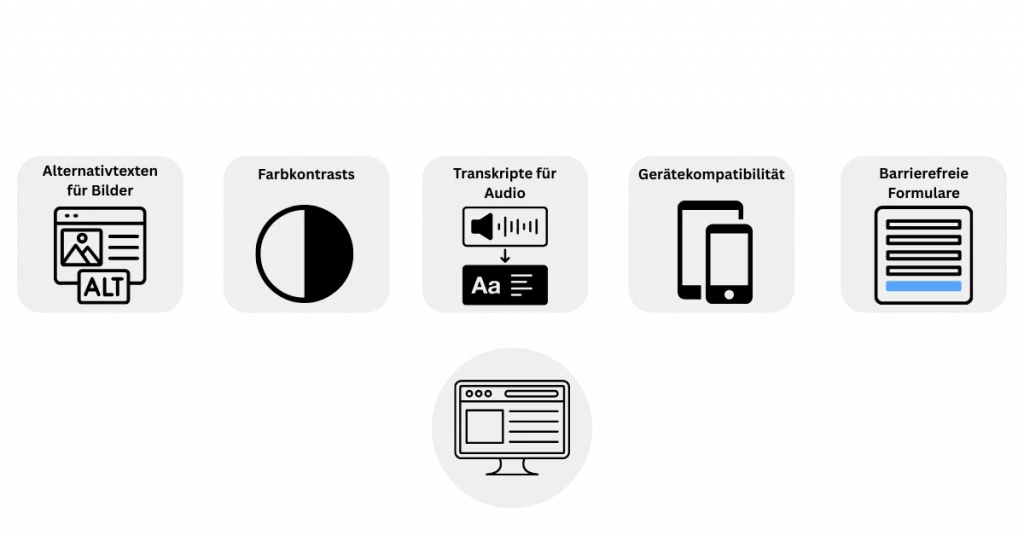
- Alternative text for all informative images
- Full keyboard usability
- Sufficient colour contrast (at least 4.5:1 for body text)
- Subtitles and transcripts for audio and video content
- Structured content with a correct heading hierarchy
- Mobile Responsiveness and Device Compatibility
- Accessible forms that are also usable with screen readers
Core specifications in detail
Who is covered
Digital platforms and applications within the EU, in both the public and private sectors. Only micro-enterprises are exempt.
What must be met
Accessibility for people with visual, hearing, motor or cognitive impairments in accordance with WCAG 2.1 Level AA.
A standard for the EU
A uniform European standard reduces legal uncertainty and makes compliance easier for companies operating across borders.
Who controls
Each Member State independently monitors this – with penalties, service bans, and legal action up to market withdrawal.
How is the law overseen and enforced?
Each EU Member State is responsible for its own monitoring and enforcement. In Germany, there are responsible market surveillance authorities for this purpose, which regularly check whether offerings meet accessibility requirements. Initially, the focus will be primarily on public websites, before private providers are increasingly scrutinised.
The enforcement includes, among other things:
- Sanctions and Fines
- Prohibition or blocking of digital services
- Legal steps up to and including market withdrawal
In addition, there is a practical risk: consumer associations and affected users can report infringements. In our experience, the initial pressure does not come from authorities, but from complaints from users.
What companies should do now
- Understanding the law: Check BFSG and the associated statutory ordinance (BFSGV) against your own use case.
- Measuring accessibility Employ automated tools such as WAVE, axe or Lighthouse – supplemented by manual testing.
- Implement changes Integrate alt text, subtitles, ARIA roles, and accessible forms.
- Enable feedback Offer users an accessible feedback option.
- Document measures Record implemented steps internally and document them in an audit-proof manner.
Important to know
Automated tools typically identify around 30 to 40 percent of actual barriers. They are an excellent starting point and reliably uncover the most common technical errors, but they do not replace manual testing with a keyboard and screen reader.
Technical focus areas
| Area | Requirement in practice |
|---|---|
| Keyboard navigation | All functions accessible without a mouse, focus always visible, no focus traps. |
| Alternative text | Every informative image describes its content; purely decorative graphics remain blank.alt=""). |
| Subtitles & Transcripts | Mandatory for video and audio content, including auto-playing media. |
| Clear link text | Download price list as PDF. |
| Form Labels | Each field has a linked |
| Website structure | Semantic HTML, a gapless heading hierarchy, actual landmarks instead of <div>Deserts. |
Is your website compliant with the Accessibility Act?
Five questions, answered honestly. The result is not a legal assessment, but an indication of how urgent the need for action is.
Brief self-assessment
0 of 5 answered
Early action saves costs, effort and legal risks later on.
Synext IT makes your website accessible
We develop websites that comply with the requirements of the Accessibility Act and WCAG 2.1 AA standards — without sacrificing design or conversion.
Our Services at a Glance
From initial analysis to ongoing support.
- Full accessibility audits including WCAG compliance check
- Redesigns and adaptations for the web and mobile devices
- Screen reader and keyboard control compatibility
- Accessible forms, navigation, and content blocks
- Semantic HTML and structured data (Schema.org)
- Optimization of color contrasts, font sizes, and visual readability.
Don’t wait for a complaint — make your website future-proof now.
Frequently Asked Questions
What is the main objective of the Accessibility Act?
The main objective is to make digital products and services accessible to all users — especially those with disabilities. The law promotes equal access to technology across the EU by creating uniform standards, particularly for websites, e-commerce, banking, and public services.
Does the Accessibility Act also apply to websites?
Yes. It applies specifically to websites and mobile applications provided by both public and private organisations. Every provider of digital services — particularly in e-commerce, finance or transport — must ensure that their website complies with accessibility standards, typically WCAG 2.1 Level AA.
How can I check my website for accessibility?
Ideally, using a combination of automated tools and manual testing:
- Automated testing with our Accessibility tool, WAVE, Lighthouse or axe DevTools
- Test operation using the keyboard only
- Using screen readers like NVDA or VoiceOver
- Check colour contrasts, alt text, heading structure and form labels
- Assessing mobile usability and responsiveness
A professional accessibility audit is recommended to ensure a reliable assessment.
Which standard currently applies to accessible websites?
The relevant standard is WCAG 2.1 Level AA (Web Content Accessibility Guidelines) from the W3C Web Accessibility Initiative, which is enshrined in Europe through the EN 301 549 standard. The guidelines are based on four principles: perceivable, operable, understandable and robust.
What penalties are incurred for non-compliance?
Market surveillance authorities can object to deficiencies, set deadlines for their elimination, impose fines and, in an extreme case, prohibit the provision of the service. What is crucial in practice is that those who demonstrably work on implementation and document this are in a significantly better position than a provider taking no action whatsoever.
Can Synext IT help with implementing accessibility?
Yes. We specialise in developing and optimising accessible websites in accordance with the requirements of the Accessibility Act. Our services include:
- Accessibility audits and technical reports
- Web design and development in accordance with WCAG 2.1
- Accessible forms, navigation and menus
- Compatibility with screen readers and keyboard navigation
- Ongoing assistance, support and monitoring
Next step
Check first, then plan.
Most websites fail because of four or five recurring issues — not because of a complete overhaul. A quick check will show you where you stand in a matter of minutes.
- Reply within 24 hours
- 100 % (no obligation)
- Specific findings rather than general guidelines
Free tool
Accessibility Check
Enter URL, get results: Contrasts, alt texts, structure and forms — checked according to WCAG 2.1 AA.
Check your website nowNo registration required · Results in under a minute
 English
  German